
Chemical plant shutdowns are among the most nitrogen-intensive operations in industrial maintenance. Whether it’s a planned annual turnaround, a corrective maintenance shutdown for a failed exchanger, or a regulatory inspection requiring full unit isolation, nitrogen services are involved at nearly every step — from initial product displacement to final startup readiness confirmation.
This guide covers the nitrogen requirements for chemical plant and industrial facility shutdowns, common field mistakes that cause schedule delays, and how to work with a nitrogen service provider to keep your shutdown on track.
Why Chemical Plants Rely Heavily on Nitrogen During Shutdowns
The core reason is safety. Chemical plant processes involve flammable, toxic, and reactive materials that cannot be safely exposed to air or moisture during maintenance. Nitrogen — inert, dry, and readily available in high-pressure gaseous form — is the standard medium for creating safe working conditions in process equipment.
Additionally, nitrogen’s properties make it useful for:
- Leak testing to verify flanged joint and valve integrity after maintenance
- System drying to remove moisture from process equipment that cannot tolerate water contamination
- Instrument air simulation for valve stroke testing during shutdown periods
- Pad gas on sensitive equipment during extended outage periods
The Shutdown Nitrogen Sequence
A well-planned chemical plant shutdown follows a defined nitrogen sequence that mirrors the unit isolation and preparation steps:
Step 1: Pre-Shutdown Planning
Nitrogen requirements should be defined before the shutdown begins. Key inputs include:
- Unit volume (piping + vessel internal volumes in cubic feet)
- Required nitrogen purity level (99.5% for hydrocarbon displacement; 99.9%+ for moisture-sensitive equipment)
- Delivery pressure needed at the tie-in point
- Duration and phasing of nitrogen use across the shutdown schedule
Early coordination with your nitrogen service provider ensures availability and eliminates last-minute logistics problems — a common cause of shutdown schedule extensions.
Step 2: Unit Depressurization and Initial Purge
Once the unit is taken offline and product inventories are reduced, a nitrogen purge sweeps residual hydrocarbons from the process train. The purge continues until gas analyzer readings confirm hydrocarbon concentrations are below the threshold required for safe maintenance access (typically below 10% LEL or site-specific safe work permit requirements).
Step 3: Equipment Isolation and Opening
As vessels and heat exchangers are opened for inspection or maintenance, nitrogen is used to maintain a positive inert pressure at open flanges and nozzles, preventing air ingress and keeping the work environment safe for personnel. This is especially important when adjacent equipment is still warm or when pyrophoric scale is present in the system.
Step 4: Maintenance and Inspection Window
During the active maintenance window, nitrogen continues to be used for:
- Blanketing catalyst beds against oxidation and moisture uptake
- Purging individual piping segments as they are opened and reinstated
- Pressure testing repaired components and new-install piping
- Leak testing flanged connections before startup authorization
Step 5: Pre-Startup Drying and Conditioning
Before product reintroduction, any process equipment that was exposed to moisture — from water washes, steam cleaning, or atmospheric humidity — must be dried using heated nitrogen or high-flow dry nitrogen sweeps. Residual moisture in a reactive chemical process can cause equipment damage, product contamination, or dangerous exothermic reactions.
Dew point monitoring during the drying phase confirms when equipment is ready for product introduction. NitroTech field personnel use inline dew point analyzers to track drying progress in real time.
Step 6: Final Purge Before Restart
Before product is reintroduced, a final nitrogen purge confirms the system is inert and ready. For hydrocarbon service, this is followed by a low-pressure product introduction that displaces the nitrogen pad and confirms no blockages or flow restrictions remain.
Common Field Mistakes During Chemical Plant Nitrogen Operations
Mistake 1: Underestimating System Volume
Nitrogen volume requirements for large process units are routinely underestimated during pre-shutdown planning. Process piping volumes alone can exceed 50,000 SCF for a single distillation column skid. Add vessel internals, heat exchanger shell/tube volumes, and interconnecting lines, and a mid-size unit purge may require 100,000–200,000 SCF of nitrogen.
Under-ordering results in mid-purge supply gaps — which can allow air to re-enter partially purged equipment and require restarting the purge sequence from scratch. Always calculate system volume conservatively and confirm trailer capacity before mobilization.
Mistake 2: No Dedicated Field Supervisor
Nitrogen delivery on a chemical plant shutdown is not a drop-and-leave service. Unattended nitrogen dewars or unmanned trailers create pressure management problems, connection issues, and safety hazards. A staffed nitrogen service — where an experienced operator manages the delivery on-site — ensures continuous supply, proper pressure regulation, and immediate response to changing field conditions.
Mistake 3: Wrong Purity Specification
Standard industrial nitrogen (99.5% N™) is adequate for most hydrocarbon purge and inerting applications. However, catalyst protection, drying operations for moisture-sensitive processes, and some specialty chemical applications require higher purity nitrogen (99.9% or 99.999%). Using the wrong purity wastes time on additional purging or, worse, exposes sensitive equipment to oxygen or moisture that standard-grade nitrogen cannot adequately displace.
Mistake 4: Inadequate Tie-In Planning
Nitrogen tie-in point identification is often left too late in shutdown planning. Confirm connection points, hose routing, and pressure requirements before the nitrogen trailer arrives on-site. Delays caused by missing fittings, wrong-specification hose, or inaccessible tie-in points are common and entirely preventable.
Selecting a Nitrogen Contractor for Facility Shutdowns
For chemical plant and industrial facility shutdown work, the right nitrogen service contractor should offer:
- Staffed service: Trained field personnel on-site for the duration of nitrogen operations, not just drop-off delivery
- High-pressure capability: Ability to deliver nitrogen at the pressure required by your process without on-site booster equipment
- Dew point monitoring: Inline measurement capability for drying applications
- Documentation: Delivery records, pressure logs, and dew point data for your maintenance file and regulatory compliance documentation
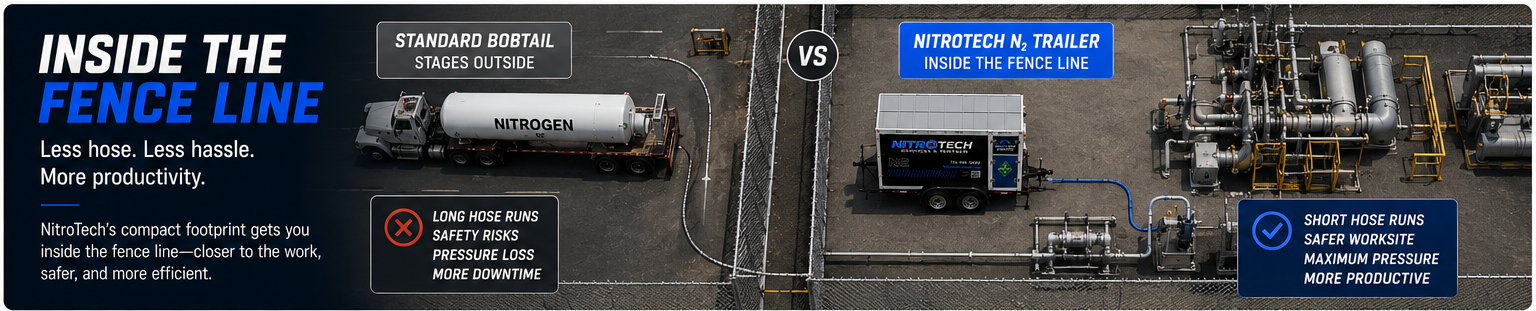
- Site access flexibility: Equipment that can reach your tie-in points — particularly important on older East Coast facilities with constrained access
NitroTech’s nitrogen technology services include all of the above. Our bumper-pull trailer design means we can access plant areas that larger nitrogen rigs cannot reach, while our high-pressure tube storage ensures you get the volume and pressure you need without resupply interruptions.
East Coast Facility Shutdown Coverage
NitroTech provides nitrogen services for industrial facility shutdowns throughout Pennsylvania, New Jersey, Delaware, Maryland, Ohio, West Virginia, and Virginia. For turnarounds and shutdowns at East Coast petrochemical, chemical, and specialty manufacturing facilities, contact NitroTech early in your planning window to confirm equipment availability and scope requirements.
Planning a Facility Shutdown?
Contact NitroTech to confirm nitrogen trailer availability and scope requirements for your maintenance window.
Related Resources
NitroTech Rentals is a division of HydroTech Testing — providing nitrogen services, hydrostatic testing, and advanced field services to industrial facilities across the United States.