
East Coast industrial facilities — from petrochemical complexes in New Jersey and Delaware to chemical plants along the Gulf-Atlantic corridor and LNG import terminals from Maryland to Massachusetts — rely on nitrogen at every stage of the asset lifecycle. Construction crews need nitrogen to purge and pressure-test new piping systems before first fill. Maintenance teams need it for safe isolation, inerting, and equipment turnarounds. And commissioning engineers need it to dry and condition systems ahead of startup.
This guide covers how nitrogen services are used across East Coast industrial facilities, what to look for in a nitrogen service provider, and why NitroTech’s advanced N2 solutions are built for the access and logistics challenges specific to the Northeast and Mid-Atlantic.
Why East Coast Facilities Have Unique N2 Logistics Challenges
The Northeast and Mid-Atlantic are home to some of the most constrained industrial job sites in North America. Older refineries, chemical plants, and power facilities were built before modern trailer sizing became standard. Many have:
- Narrow access roads and low overhead clearances that block full-size nitrogen trailers
- Congested plant layouts where maneuvering a semi-pull trailer is impractical or impossible
- Municipal permit restrictions on heavy vehicle access in port and urban industrial zones
- Strict scheduling windows driven by environmental permits and union shift agreements
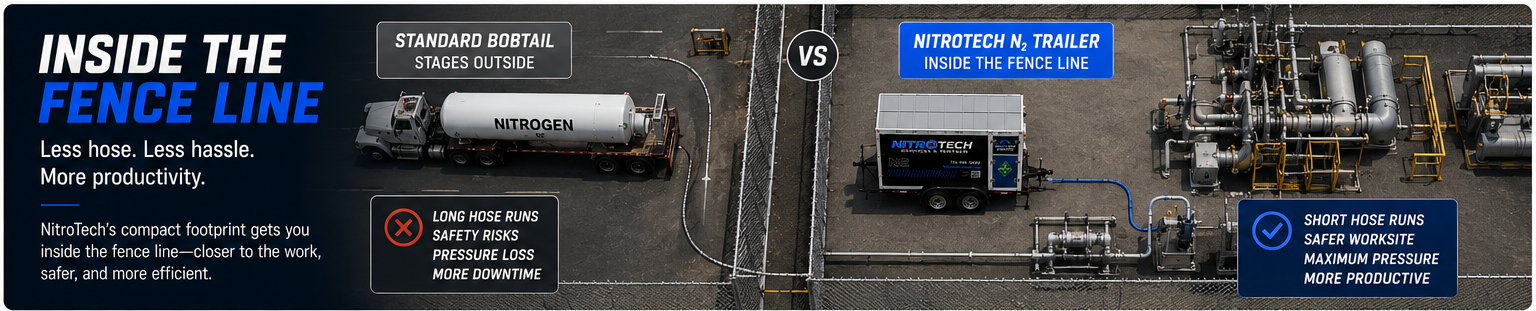
NitroTech’s bumper-pull nitrogen trailer is designed specifically for these conditions. It carries more product than a competitor’s bobtail — and it moves with a standard pickup truck, not a semi-tractor semi. That means faster mobilization, simpler logistics, and the ability to access sites where larger rigs simply cannot go.
Construction Phase: Purging and Pressure Testing New Piping
Before any new process piping system on an East Coast facility can be placed in service, it must be purged of oxygen and moisture, then pressure-tested to verify integrity. Nitrogen is the standard medium for both operations:
Inert Purge Before First Fill
New piping systems contain atmospheric oxygen that must be displaced before introducing hydrocarbons, cryogenic fluids, or reactive chemicals. A nitrogen purge sweeps out the oxygen, reducing O™ concentration to safe levels before product introduction. For East Coast LNG terminals, this also includes pre-cooling the cryogenic transfer lines with gaseous nitrogen before liquid nitrogen or LNG flows.
Pneumatic Pressure Testing
Some new piping systems on East Coast industrial facilities are tested pneumatically (with nitrogen pressure) rather than hydrostatic (with water) when:
- The system cannot tolerate residual moisture after a water test
- The structure cannot support the weight of a water fill
- The operating fluid is incompatible with water contamination
- Rapid testing turnaround is required to meet construction schedule
NitroTech provides high-pressure nitrogen delivery for pneumatic testing, with field personnel who understand ASME B31.3 and B31.8 test procedures and safety requirements for pressure hold periods and incremental pressurization protocols.
Maintenance Phase: Inerting, Isolation, and Purge-to-Atmosphere
Across the asset lifecycle, East Coast industrial facilities call on nitrogen services most frequently during planned and unplanned maintenance:
Vessel and Equipment Inerting
Before maintenance personnel enter or work on process vessels, reactors, heat exchangers, or storage tanks, the equipment must be rendered safe. Nitrogen inerting displaces flammable or toxic vapors, reducing hydrocarbon concentrations to below LEL (Lower Explosive Limit) and O™ to levels safe for hot-work permits or confined space entry preparation.
Line Isolation and Purging
When a section of process piping must be isolated for maintenance, a nitrogen purge ensures the isolated segment contains no residual product before blinds or blanks are installed. After maintenance is complete, nitrogen is again used to purge the isolated section before reintroducing process fluid.
Catalyst Bed Maintenance
Refineries and chemical plants on the East Coast that operate catalytic reactors — hydroprocessing units, reformers, crackers — require nitrogen blanketing of catalyst beds during unloading, reloading, and regeneration procedures to prevent oxidation and moisture uptake.
Turnaround Support for East Coast Refineries and Chemical Plants
Major facility turnarounds on the East Coast — including Delaware Valley refineries, New Jersey petrochemical complexes, and Appalachian chemical plants — involve coordinated nitrogen delivery over extended periods, often spanning several weeks. Key turnaround nitrogen applications include:
- Initial unit purge at shutdown: sweep hydrocarbons from process equipment before maintenance begins
- Nitrogen blanketing during equipment opening: maintain inert atmosphere as vessels and exchangers are opened to air
- Purge-to-atmosphere after maintenance: clear the unit of nitrogen before reintroducing feed
- Pressure testing of repaired or replaced components before restart
NitroTech provides a dedicated field supervisor for turnaround jobs, coordinating nitrogen delivery to match the turnaround work sequence and unit handoff schedule — minimizing schedule delays caused by nitrogen availability or logistics.
LNG and Cryogenic Facilities on the East Coast
The East Coast hosts several LNG import terminals, peak-shaving facilities, and cryogenic storage operations — particularly in New England where LNG supplements pipeline capacity during peak heating demand. Nitrogen plays a unique role in these facilities:
- Pre-cooldown preparation: Gaseous nitrogen is used to purge and initially cool cryogenic transfer lines before LNG introduction, preventing thermal shock to equipment
- Boil-off gas management: Nitrogen is used to manage inert gas blankets on LNG storage tanks during maintenance and inspection windows
- Instrumentation and control line purging: Low-temperature instruments require nitrogen purging to prevent moisture freeze in signal lines
What to Look for in a Nitrogen Service Provider for East Coast Facilities
Selecting a nitrogen contractor for East Coast industrial work involves more than comparing gas prices. Key criteria include:
- Equipment access capability: Can the trailer physically reach your site? Bumper-pull trailers offer access that full-size rigs cannot match in congested plant environments.
- Field supervision: Staffed nitrogen service — where a trained operator manages the delivery on-site — is safer and more efficient than drop-and-leave liquid nitrogen dewars.
- Pressure capability: Verify that the trailer can deliver at the pressures your job requires. High-pressure tube trailers eliminate the need for on-site boosters in most industrial applications.
- Response time: East Coast turnarounds and emergency maintenance windows do not wait. Confirm the provider’s mobilization timeline from call to on-site.
- Safety documentation: DOT-compliant equipment, current FMCSA filings, and field personnel with nitrogen operations training should be non-negotiable requirements.
NitroTech Coverage Across the East Coast
NitroTech provides nitrogen trailer services across the Eastern United States, with deployment capability to reach the Northeast and Mid-Atlantic industrial corridor. Key service areas include New Jersey, Pennsylvania, Delaware, Maryland, Virginia, West Virginia, and North Carolina, as well as the Ohio River Valley chemical corridor.
For East Coast facilities in the planning stages of a turnaround, construction project, or maintenance campaign, early coordination with NitroTech ensures equipment availability, proper trailer positioning logistics, and the right field staffing for your scope.
Plan Your East Coast N2 Requirements
Contact NitroTech to discuss your facility’s nitrogen needs — from a single pressure test to full turnaround support.
Related Resources
NitroTech Rentals is a division of HydroTech Testing — providing nitrogen services, hydrostatic testing, and advanced field services to industrial facilities across the United States.