
The single specification that most nitrogen service customers do not think about, but that drives more of their actual project cost and schedule than almost anything else, is the operating pressure of the nitrogen storage system on the trailer. High-pressure tube storage versus standard lower-pressure tank storage is not a small technical detail. It is the difference between completing a multi-test job on one fill or waiting for a resupply mid-operation.
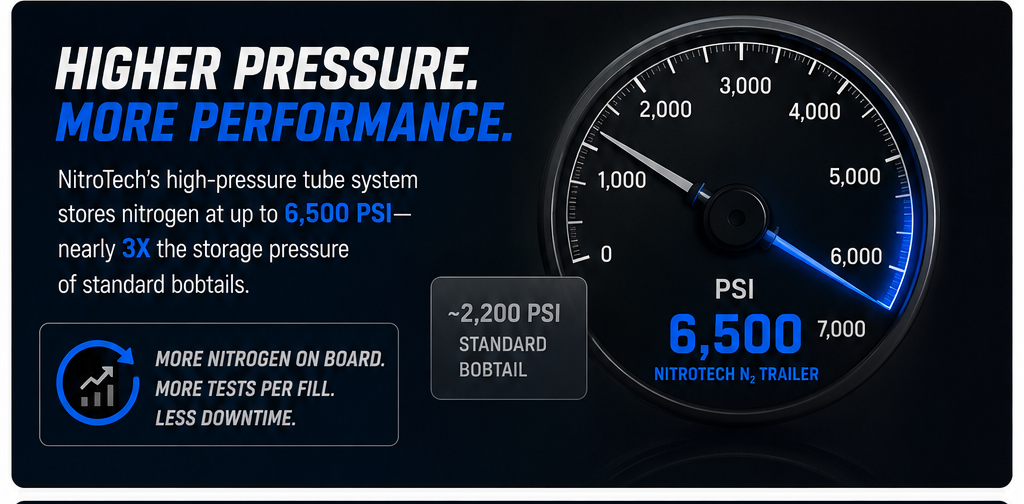
NitroTech’s high-pressure tube design is the third of three core engineering decisions that define our advanced N2 solutions positioning. We don’t pretend to be the right answer for every nitrogen application. We built high-pressure tube trailers specifically because we believed multi-test efficiency for pressure testing and commissioning operations was an area where we could engineer the equipment meaningfully better than the standard industry approach.
High-pressure tube storage exists because we focused on a specific class of nitrogen work — back-to-back testing, pressure operations, and commissioning sequences where multi-test efficiency drives the project schedule. If your job is a single low-pressure purge, you don’t need this equipment. If your job is a series of pressure tests where every resupply costs you a day, this is exactly the equipment that was built for your work.
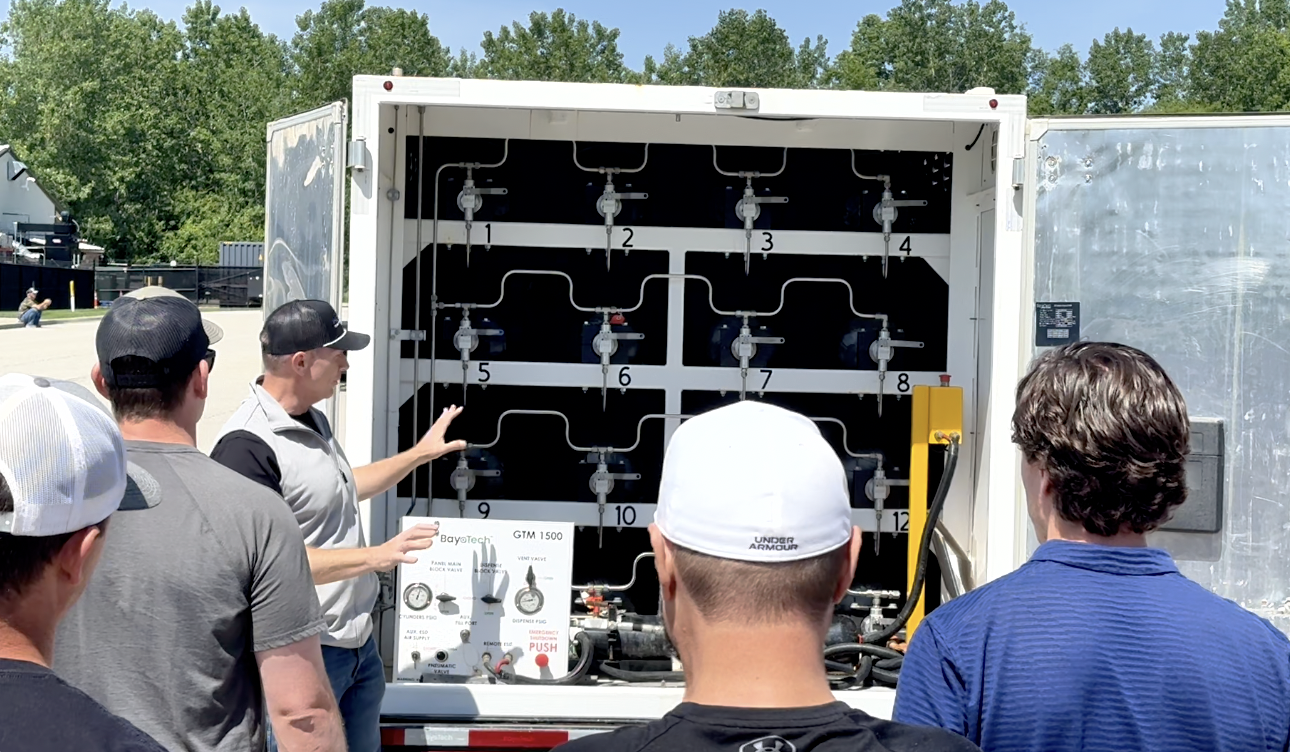
The Pressure Versus Volume Trade-Off in Nitrogen Storage
Nitrogen storage on a trailer involves a fundamental engineering trade-off between volume (the physical size of the tank or tubes) and pressure (how much nitrogen is compressed into that volume). Standard nitrogen bobtails use large lower-pressure tanks. High-pressure tube trailers use multiple smaller-diameter tubes rated for significantly higher operating pressure.
The reason the standard industry approach is lower-pressure tanks is that they are simpler and cheaper to manufacture. The reason this approach is a poor fit for multi-test operations is that nitrogen storage at lower pressure delivers less usable nitrogen at typical industrial test pressures — meaning more fills are required to complete the same work.

What Multi-Test Efficiency Actually Means
The term “multi-test efficiency” describes a specific operational reality: many industrial nitrogen jobs involve multiple sequential pressure tests, purges, or commissioning operations performed at the same site over hours or days. Each operation consumes nitrogen. When the trailer’s storage pressure drops below the minimum required for the next test, work stops until resupply arrives.
The number of tests completable per fill is the most important specification for these operations. Two trailers with the same total nitrogen capacity but different storage pressures will deliver dramatically different numbers of completed tests before requiring resupply.
The Math of Usable Nitrogen Per Fill
Here is the simplified principle. A nitrogen storage system delivers usable product down to the test pressure your job requires. Any nitrogen that remains in the trailer at pressures below your job’s minimum is unusable for that test — it stays in the tank.
For a pressure test requiring 600 PSI delivered pressure (a typical mainline pneumatic test):
- A standard 2,200 PSI bobtail starts the day with significant capacity, but the usable portion above 600 PSI test pressure (with appropriate margin) is a fraction of total stored volume
- A high-pressure 6,500 PSI tube trailer starts the day with substantially more nitrogen pressure-above the test pressure, meaning a much larger fraction of stored volume is usable for the test
This is why a properly designed high-pressure tube trailer can carry more total stored nitrogen, deliver more usable nitrogen at typical test pressures, and complete more tests per fill than a similar-footprint lower-pressure bobtail.
Real-World Example: Pressure Testing Five Segments
A pipeline construction project has five separable test segments. Each requires a hydrostatic pre-test nitrogen purge plus a follow-up pneumatic leak test at operating pressure. The total nitrogen demand is significant but each individual test consumes a fixed quantity.
Operating with a lower-pressure bobtail, the typical sequence is:
- Complete tests 1 and 2 in the morning
- Storage pressure drops below test threshold during test 3
- Job paused, resupply dispatched, half-day delay
- Resume tests 3, 4, 5 the following morning
Operating with NitroTech high-pressure tube trailers, the typical sequence is:
- Complete tests 1, 2, 3, 4 sequentially through the day
- Test 5 completed by end of shift on the same fill
- Crew demobilizes, project moves to next phase one day ahead of bobtail schedule
Across a multi-month construction project with multiple multi-test sequences, the schedule difference is significant. Across a refinery turnaround with continuous pressure testing of repaired components, it is operationally decisive.
Data Center Fire Suppression Cylinder Recharge
One of the highest-value applications for high-pressure tube storage is data center fire suppression system recharge after a discharge test. Inert gas fire suppression systems — IG-100 nitrogen, IG-541 nitrogen-argon blends, IG-55 blends — require cylinder recharge to system operating pressure (typically 2,200 PSI or higher) before the protected space can return to service.
The speed of cylinder recharge directly determines how long the IT room is offline. For hyperscale data center operators, every hour of room offline time has direct revenue consequences. High-pressure tube trailer supply can directly accelerate the recharge process compared to waiting for pre-filled replacement cylinders from a remote supplier.
Commissioning Sequence Time Compression
Data center and industrial facility commissioning involves a defined sequence of nitrogen operations. Pressure testing, drying, inerting, and pre-startup purging are typically performed in a specific order, each operation needing to complete before the next begins. A nitrogen supply interruption mid-sequence compresses against the entire downstream schedule.
High-pressure tube trailers complete more sequence steps per fill, reducing the probability of mid-sequence resupply interruption and reducing the schedule risk that comes with each fill transition. For East Coast commissioning projects on tight schedules — particularly Northern Virginia data center campuses where commissioning delays have major revenue implications — this sequence-compression value is substantial.
When Standard Storage Is Fine
To stay honest: for a single low-pressure purge operation — one tank, one shot, no follow-up tests — the storage pressure of the trailer is not particularly important. Any trailer with sufficient total capacity completes the job. Standard storage is fine for single-operation jobs.
NitroTech is not the right answer for single-operation jobs where total capacity is the only requirement. We focus on multi-test operations, commissioning sequences, and applications where storage pressure efficiency translates to schedule compression. That is the work we engineered the equipment for. That is the work we are good at. If your job is a one-shot purge, hire a one-shot purge service. If your job is a multi-day commissioning sequence, that is exactly where we work.
Multi-Test Project? Get the Right Equipment.
Contact NitroTech to discuss whether high-pressure tube storage is the right fit for your project. We’ll be straight with you about whether the efficiency gain justifies the service.
Related Resources
NitroTech Rentals is a division of HydroTech Testing — advanced N2 solutions, engineered where it matters. Nitrogen services, hydrostatic testing, and field operations support across the Eastern United States.