
If you have ever stood at a refinery gate watching a 53-foot bobtail nitrogen rig negotiate a turn that was designed for service trucks twenty years ago, you already understand the problem. The nitrogen industry has spent two decades building bigger and bigger rigs — on the theory that more capacity is always better — while the jobsites the equipment actually has to reach have not gotten any bigger. They have gotten more constrained, more crowded, and more permit-restricted with every passing year.
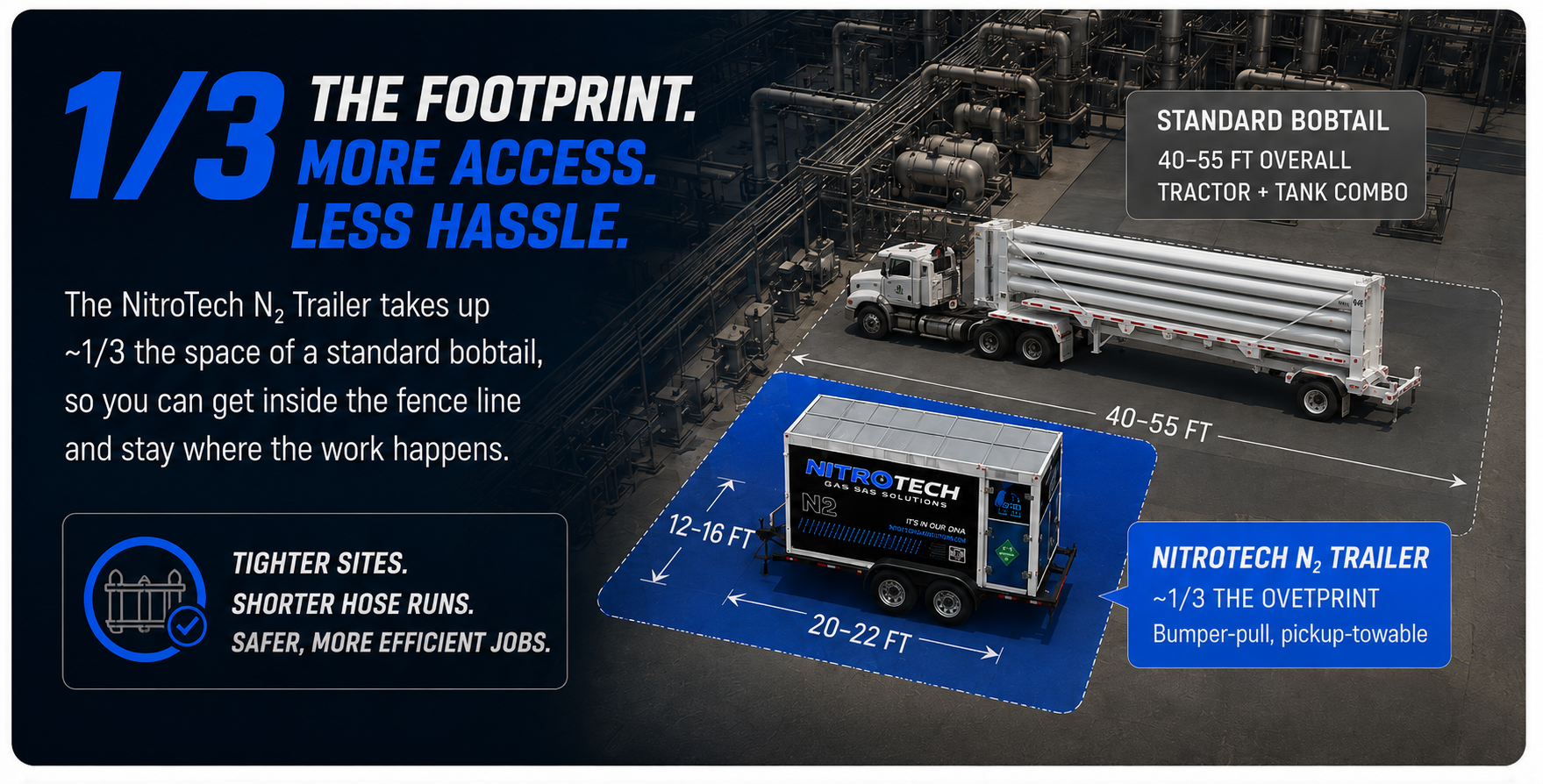
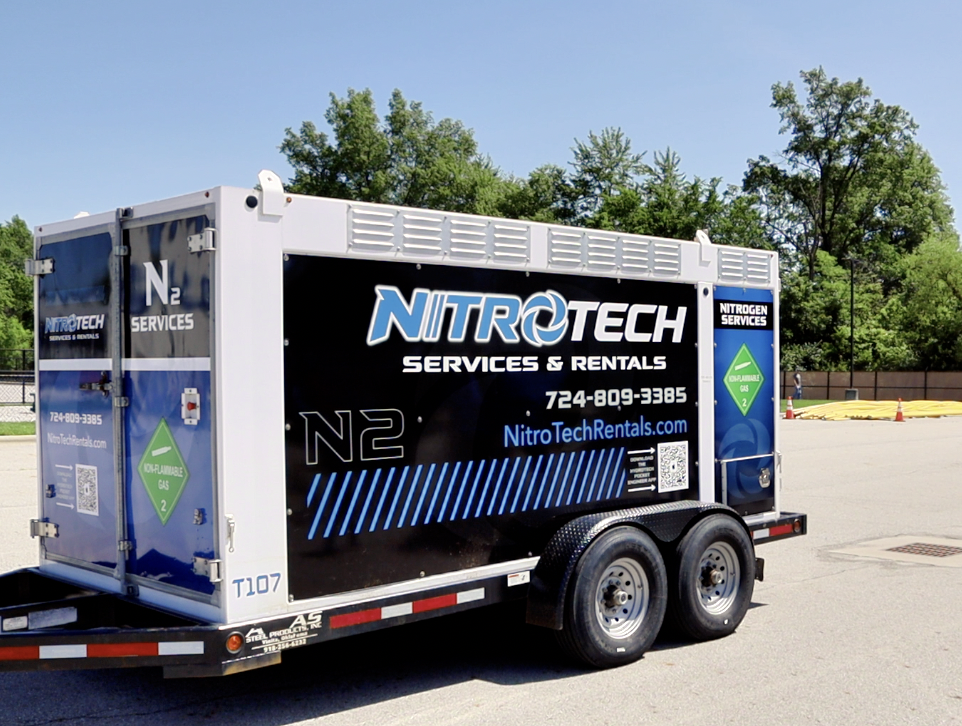
NitroTech approaches this problem from the other direction. Our bumper-pull nitrogen trailers carry more product than competitors’ bobtails — in a footprint that fits where the big rigs cannot go. This is not a marketing claim. It is the central engineering decision that defines NitroTech as an advanced N2 solutions company rather than a commodity rental shop. We don’t pretend to compete on catalog breadth. We compete on whether our equipment can actually get to the tie-in point.
NitroTech doesn’t build equipment for a brochure. We build equipment for the field — where access, mobilization, and execution matter more than catalog specifications. The bumper-pull design exists because we believed we could engineer it meaningfully better than the standard bobtail. If a standard catalog rig solves your problem, you don’t need us. If it can’t reach your tie-in, that’s exactly where we work.
The Real-World Cost of Trailer Footprint
Trailer footprint is one of those specifications nobody talks about until it matters. And then it is the only thing that matters. Here is what trailer footprint actually determines on a real industrial job:
- Whether you can mobilize at all. If the access road can’t accept a tractor-trailer combination, your nitrogen project does not start — regardless of trailer capacity.
- How long it takes to stage equipment. A smaller footprint trailer can be repositioned by one operator with a pickup. A bobtail requires a CDL driver and significant maneuvering room.
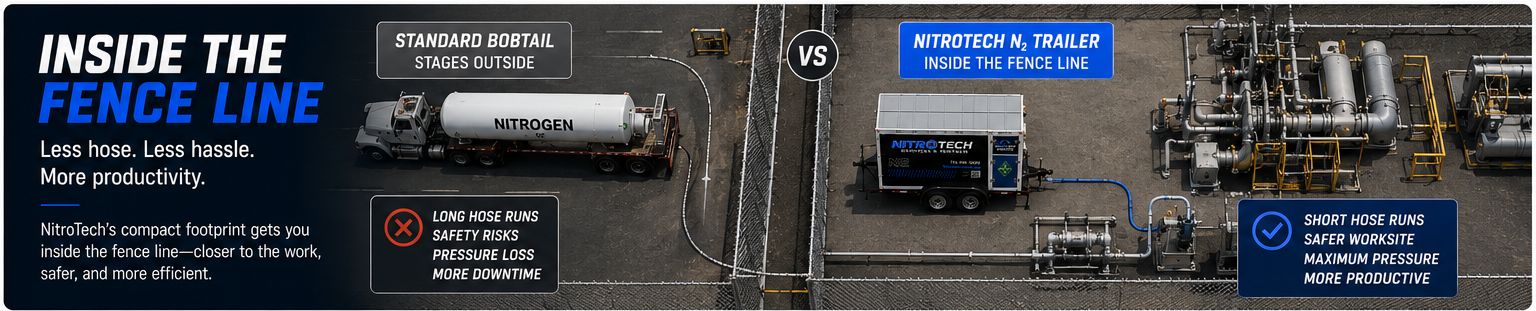
- Where you can park during operations. Tight refinery and chemical plant access often means a bobtail has to stage outside the unit fence line, requiring hundreds of feet of high-pressure hose — with all the pressure drop, leak risk, and management headaches that creates.
- Who has to be in the loop on logistics. Larger rigs need municipal route permits, weight permits, and longer site access coordination. Bumper-pull trailers move on standard roads with standard pickups, no special permits required for most routes.
- How adjacent trades interact with you. A bobtail blocking 40 feet of access road during operations affects everyone’s schedule. A bumper-pull trailer next to a service truck does not.
Bumper-Pull vs. Bobtail: The Honest Comparison
A nitrogen bobtail is a self-contained rig: tractor and tank as one unit, typically 35–55 feet long, requiring a Class A CDL operator. A bumper-pull nitrogen trailer separates the towing vehicle from the trailer — meaning the same trailer can move with any pickup truck rated for the load.
The standard industry assumption is that bigger means more capacity, and more capacity means better service. But the NitroTech bumper-pull design carries more high-pressure nitrogen product than typical competitors’ bobtails — in a footprint that fits where the competition’s rig physically cannot park. The engineering trade we made is this: high-pressure tube storage in a tighter form factor delivers more usable nitrogen per square foot of trailer footprint than the conventional lower-pressure, larger-tank bobtail approach.
The Specification Comparison That Actually Matters
Most nitrogen service comparisons focus on total SCF capacity. This is the wrong specification for most real jobsites. The specifications that matter are:
- Footprint at staging: How much access road and parking space does the trailer require in place?
- Operating pressure: Higher operating pressure means more usable nitrogen per fill before pressure drops below your job’s minimum threshold.
- Time-to-deploy from arrival: How long from gate entry to first usable nitrogen flow?
- Mobilization cost: CDL driver day rate plus per-mile costs vs. a standard service truck operator.
On every one of these specifications, the bumper-pull design wins for typical industrial jobs. The bobtail wins only when sustained extremely-high-volume operations require staging multiple high-capacity rigs simultaneously, which is a minority of real-world projects.
Where Bumper-Pull Wins: Five Job Types
1. East Coast Refinery Turnaround Work
Delaware Valley, New Jersey, and Pennsylvania refineries were built in eras when access roads and gate clearances were sized for service trucks, not modern semi-trailers. Bumper-pull trailers reach refinery process units that bobtails physically cannot enter without pulling fence panels — which is not a real option during turnaround operations.
2. Chemical Plant Inside-Fence Operations
Specialty chemical and pharmaceutical manufacturing facilities, particularly in the dense industrial corridors of New Jersey and Delaware, have intra-plant access roads that simply will not accommodate full-size nitrogen rigs. Bumper-pull trailers go to the equipment instead of forcing the equipment to come to the trailer.
3. Data Center Construction Sites
Active hyperscale data center construction sites in Northern Virginia, West Virginia, and Maryland are dense logistics environments with dozens of trades operating simultaneously. A bumper-pull trailer stages in spaces no semi can use, can be repositioned between buildings without dispatching a CDL driver, and does not block primary access roads while in operation.
4. LNG Facility Maintenance Windows
LNG peak-shaving facilities — particularly in New England, where many were built in the mid-20th century — have access constraints that reflect their era. Bumper-pull trailers reach LNG facility tie-in points that bobtails cannot, simplifying pre-season maintenance coordination significantly.
5. Pipeline Tie-In and Repair Work
Pipeline tie-in points are by definition not at convenient road access locations. Gathering system work, mainline repair, and integrity excavations require nitrogen equipment that can reach into ROW access roads designed for service vehicles. Bobtails work for staged operations at major facilities; bumper-pull trailers work for actual tie-in operations in the field.
The “Bigger Is Better” Myth in Nitrogen Equipment
The nitrogen industry has trained customers to think about capacity first. This makes sense for one specific type of project — sustained high-volume pipeline purges where total cubic feet of nitrogen is the binding constraint. For everything else, capacity is rarely the limiting factor. The limiting factor is whether the equipment can get to the work and stay close enough to do the work safely.
NitroTech’s engineering choice is contrarian on purpose: optimize for usable nitrogen at the tie-in point, not for total tank volume on the brochure. A bumper-pull trailer carrying high-pressure nitrogen tubes delivers more usable nitrogen at typical industrial operating pressures than a low-pressure bobtail of similar total capacity, because pressure-driven delivery extracts more product from each fill before the storage pressure drops below the job’s minimum threshold.
When You Actually Need a Bobtail
To be intellectually honest: bobtail rigs are the right answer for some jobs. Sustained mainline pipeline purging over multiple days, where total nitrogen volume is the binding constraint and the site has full semi access, is a job where a bobtail makes sense. Major refinery operations that require continuous nitrogen for weeks at a time, with permanent staging areas designed for full-size rigs, can use bobtails effectively.
NitroTech does not pretend to be the right answer for those jobs. We do not pretend to be a full-line nitrogen catalog. We are an advanced N2 solutions company that focuses on the operations where bumper-pull access, high-pressure efficiency, and field-deployable logistics make a measurable advantage. If a bobtail solves your problem, hire a bobtail company. If a bobtail cannot get to your tie-in, call us.
The Hidden Cost of Needing a Bigger Rig
The costs of needing a larger trailer do not show up on the nitrogen invoice. They show up on the surrounding schedule:
- Extended hose runs from outside-fence staging add hours of setup time, pressure drop management, and leak risk
- CDL driver mobilization adds $1,000–$3,000 per dispatch compared to a standard pickup operator
- Route permits for oversize loads add days of lead time before mobilization
- Site access disputes between trades using the same restricted access roads add coordination overhead and schedule delays
- Repositioning a bobtail mid-operation requires the CDL driver to be on standby, adding daily cost
None of these costs appear in a bobtail rental quote. All of them appear in the project’s actual cost overrun report after the work is complete.
Why This Matters for East Coast and Northeast Jobs
East Coast industrial sites — New Jersey refineries, Delaware Valley chemical plants, Pennsylvania energy infrastructure, Massachusetts LNG facilities, Northern Virginia data center campuses — were built in different eras, by different generations of designers, under different access assumptions. What they share is that none of them were designed for modern full-size nitrogen rigs. The access constraints are real, persistent, and not going to change.
This is why NitroTech focuses on the East Coast corridor. Our equipment is built for the access realities of this market. Bumper-pull trailers, pickup-truck mobilization, and high-pressure tube storage are not gimmicks — they are the engineering decisions that allow us to actually do the work on the sites where the work needs to happen.
Footprint Matters. Get the Right Equipment for Your Site.
Contact NitroTech to discuss whether bumper-pull access is right for your project. If a standard bobtail can do the job, we’ll tell you. If it can’t, that’s exactly where we work.
Related Resources
NitroTech Rentals is a division of HydroTech Testing — advanced N2 solutions, engineered where it matters. Nitrogen services, hydrostatic testing, and field operations support across the Eastern United States.