
Pipeline construction and maintenance work across the Northeast — from Marcellus and Utica gathering systems in Pennsylvania, West Virginia, and Ohio to the dense distribution networks of New York, New Jersey, and New England — is dominated by tie-in operations that take place at locations the original road planners never imagined. ROW access roads, easement clearings, and farm field tie-in points are typical pipeline work sites. None of them were designed around the dimensions of a full-size nitrogen rig.
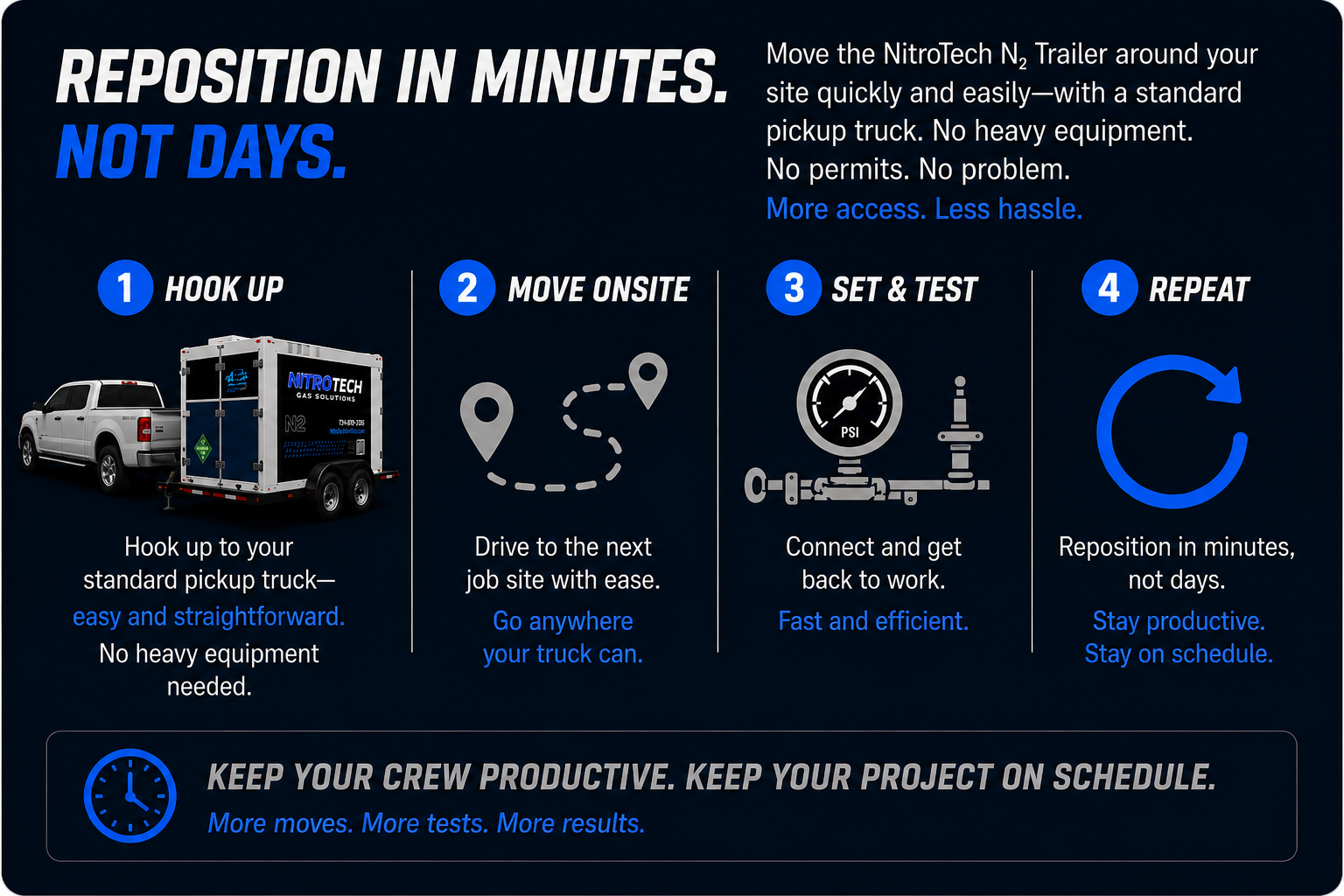
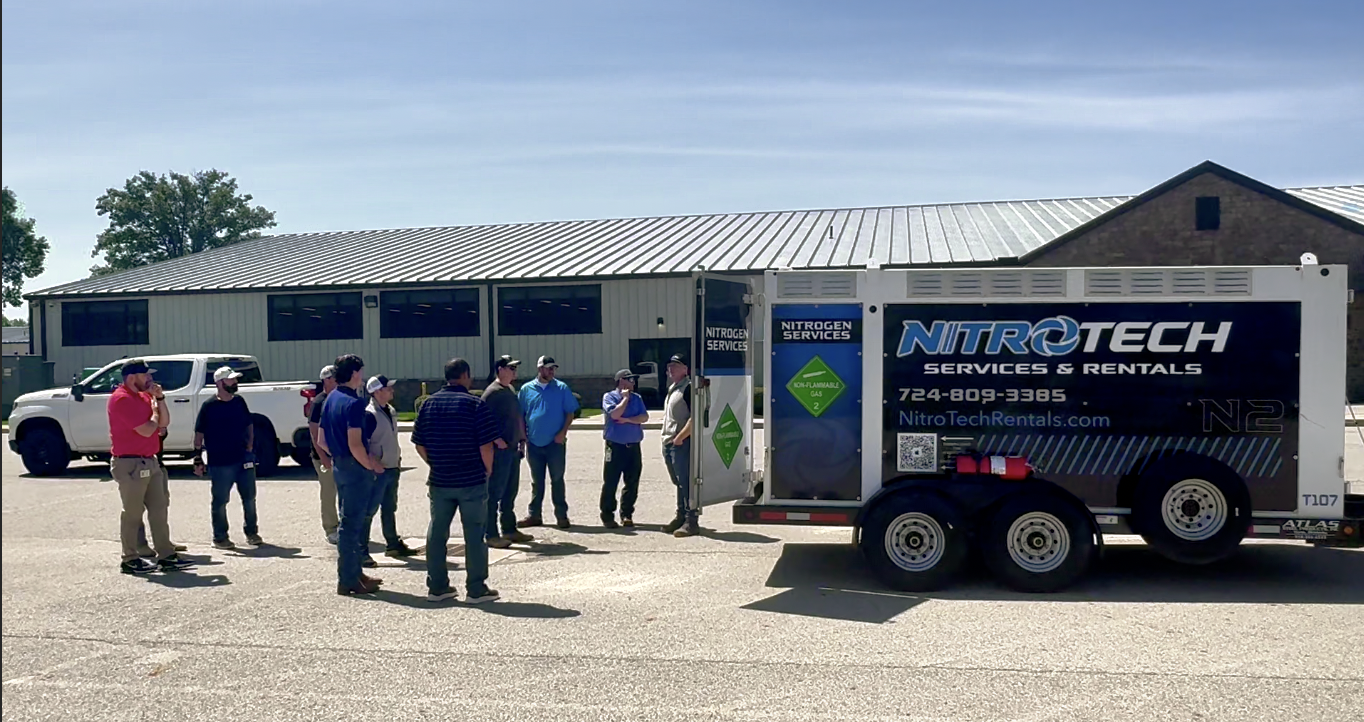
NitroTech’s pickup-towable bumper-pull trailers are not a marketing convenience — they are the engineering decision that makes nitrogen service practical at the access reality of Northeast pipeline work.
NitroTech is an advanced N2 solutions company. We focused on equipment design around the access realities of Northeast pipeline tie-in work — not because it sounded good in a brochure, but because we believed we could engineer the mobilization meaningfully better than the standard semi-tractor approach. If your project is along a highway with semi access, hire a bobtail. If your project is at the end of a ROW access road, that’s where we work.
The Tie-In Access Problem
A pipeline tie-in is, by definition, at a location chosen for the pipeline route — not for road access convenience. ROW access roads to tie-in points are typically gravel, dirt, or partially-graded surfaces designed for construction equipment. Width and weight limits often exclude commercial vehicles entirely. Even when access is theoretically possible, the turnaround radius and staging area required for a full-size nitrogen rig is rarely available.
The standard industry workaround is to stage the bobtail at the nearest improved-road location and run several hundred feet of high-pressure hose to the tie-in. This works, but introduces:
- Pressure drop across long hose runs requiring higher source pressure
- Operational complexity managing the hose route across uneven terrain
- Safety review burden for the extended pressurized hose path
- Reduced flexibility if the tie-in point needs adjustment
Pickup-towable bumper-pull trailers eliminate this workaround. The trailer goes to the tie-in. The operator goes to the tie-in. The work happens at the tie-in.
Marcellus, Utica, and Appalachian Gathering Systems
The Pennsylvania, West Virginia, and Ohio gathering system corridors are some of the most active pipeline construction zones in North America. EQT, CNX, Antero, Equitrans Midstream, and dozens of smaller operators maintain expansion and integrity work across thousands of miles of gathering infrastructure. Specific access realities of this work:
- Well pad and compression facility access roads are typically gravel or partially-improved
- Gathering line tie-ins are in farm fields, wooded ROW, or remote ridge-top locations
- Weather-dependent access conditions: spring mud, winter snow/ice, summer fire restrictions
- Regulatory access permits varying by county and state, with municipal coordination requirements that add lead time to semi-tractor mobilization
Bumper-pull trailers move through this landscape with the same agility as the service trucks the gathering system operators are already running. semi-tractor rigs face delays, route restrictions, and weight-limit constraints that often eliminate them from consideration entirely for tie-in work.
New York and New England Distribution Replacement Work
The other side of Northeast pipeline work is utility gas distribution replacement — Con Edison, National Grid, NSTAR/Eversource, and similar urban gas distribution operators replacing legacy cast iron mains with modern polyethylene and steel. This work happens on city streets, under residential neighborhoods, and through permit-restricted urban industrial zones.
Urban distribution work access constraints:
- Commercial vehicle weight and route restrictions in dense urban areas
- Limited overnight staging space for equipment between work phases
- Permit complexity for oversize commercial vehicles in residential neighborhoods
- Restricted street parking for utility equipment during operations
Bumper-pull trailers fit utility work logistics the way service trucks do. They park where utility crews already operate, move between work zones with utility crew mobility, and operate under standard vehicle rules that match the operating model of the utility.
Mobilization Speed on Pipeline Work
The semi-tractor logistics bottleneck is particularly acute on pipeline tie-in work. A tie-in is a coordinated operation that involves multiple crews, weather windows, regulatory notifications, and tight scheduling. Mobilization windows for tie-in work are often 24–48 hours from notification to execution — a window that semi-tractor-mounted nitrogen mobilization frequently cannot meet without extra cost.
Pickup-towable trailers compress the mobilization timeline:
- Same-day dispatch is operationally routine
- The operator who runs the nitrogen work also handles the mobilization, eliminating the dispatch coordination layer
- Standard road movement means no permit lead times for typical mobilization distances
- Re-routing for traffic or weather delays is straightforward without CDL hours-of-service constraints
Weather Windows and After-Hours Tie-Ins
Pipeline tie-ins are weather-sensitive operations. Welding cannot happen in rain. Excavation cannot happen in deep mud. Hot work permits are restricted in dry/fire-warning conditions. Tie-in execution often happens in narrow weather windows that may open with little advance notice.
When a tie-in weather window opens unexpectedly, the question is how fast nitrogen can be on location. semi-tractor dispatch typically cannot meet a same-day weather window. Pickup-towable mobilization can. For Northeast pipeline contractors managing weather-sensitive tie-in schedules — particularly in spring and fall transitional weather — this responsiveness is a meaningful operational advantage.
When Mainline Rigs Are Still the Right Answer
For sustained mainline pipeline purging operations — multi-day continuous nitrogen flow moving down a pipeline ROW — full-size rigs with continuous staging make operational sense. NitroTech does not pretend to be the right answer for those operations. We are an advanced N2 solutions company focused on tie-in operations, gathering system work, distribution work, and the constrained-access pipeline operations where mobilization speed and access matter more than sustained continuous flow.
Pipeline Tie-In? Get the Right Nitrogen Logistics.
Contact NitroTech to discuss your pipeline tie-in nitrogen requirements. We’ll be honest about whether pickup-towable mobilization is the right fit for your operation.
Related Resources
NitroTech Rentals is a division of HydroTech Testing — advanced N2 solutions, engineered where it matters. Nitrogen services, hydrostatic testing, and field operations support across the Eastern United States.