
Industrial nitrogen service is dominated by equipment that requires a Class A CDL driver to move. This is just an accepted fact of the industry. Need nitrogen? Hire a service that includes a CDL operator. Need to reposition between sites? Wait for the CDL driver to be dispatched. Need to mobilize fast? You can’t.
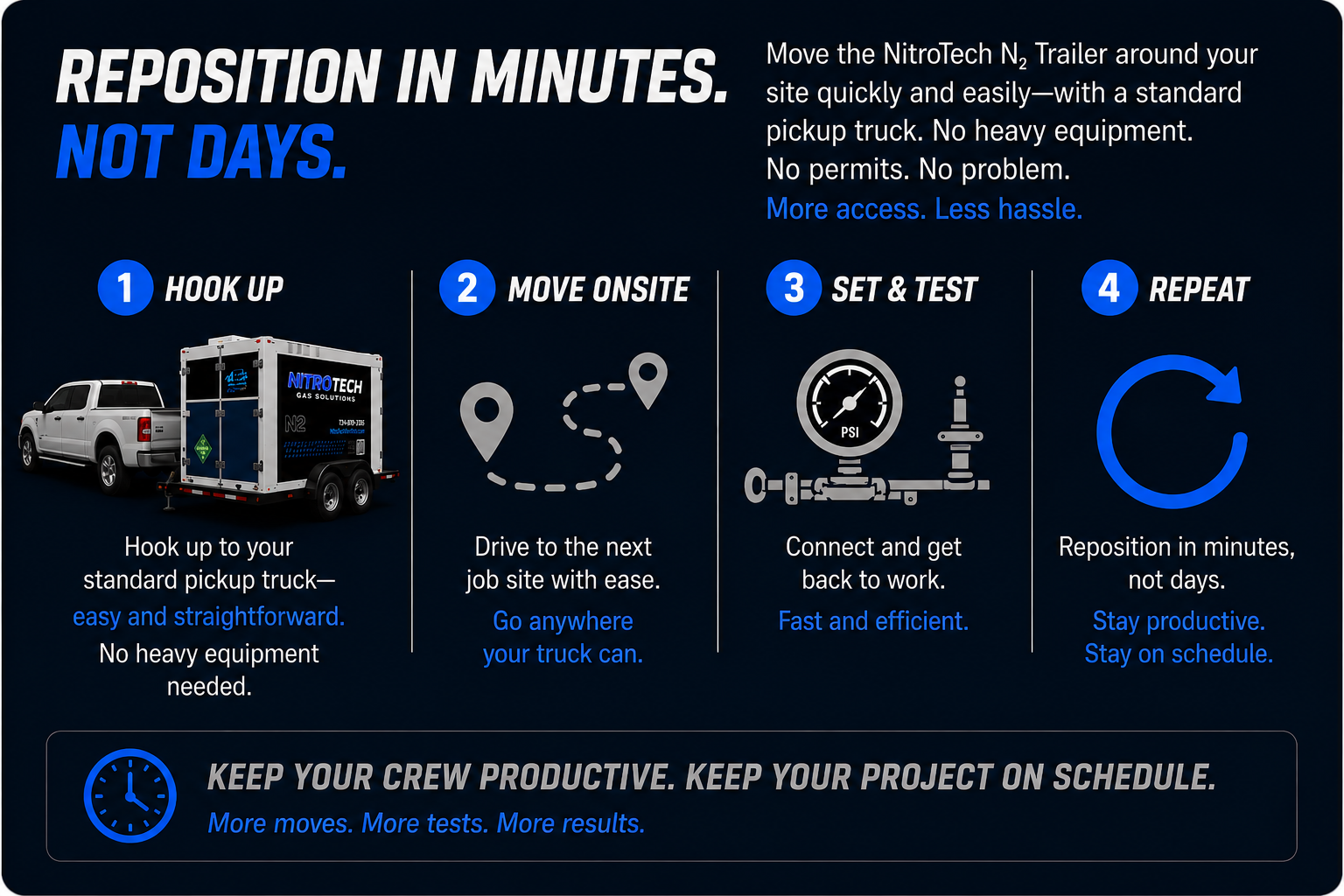
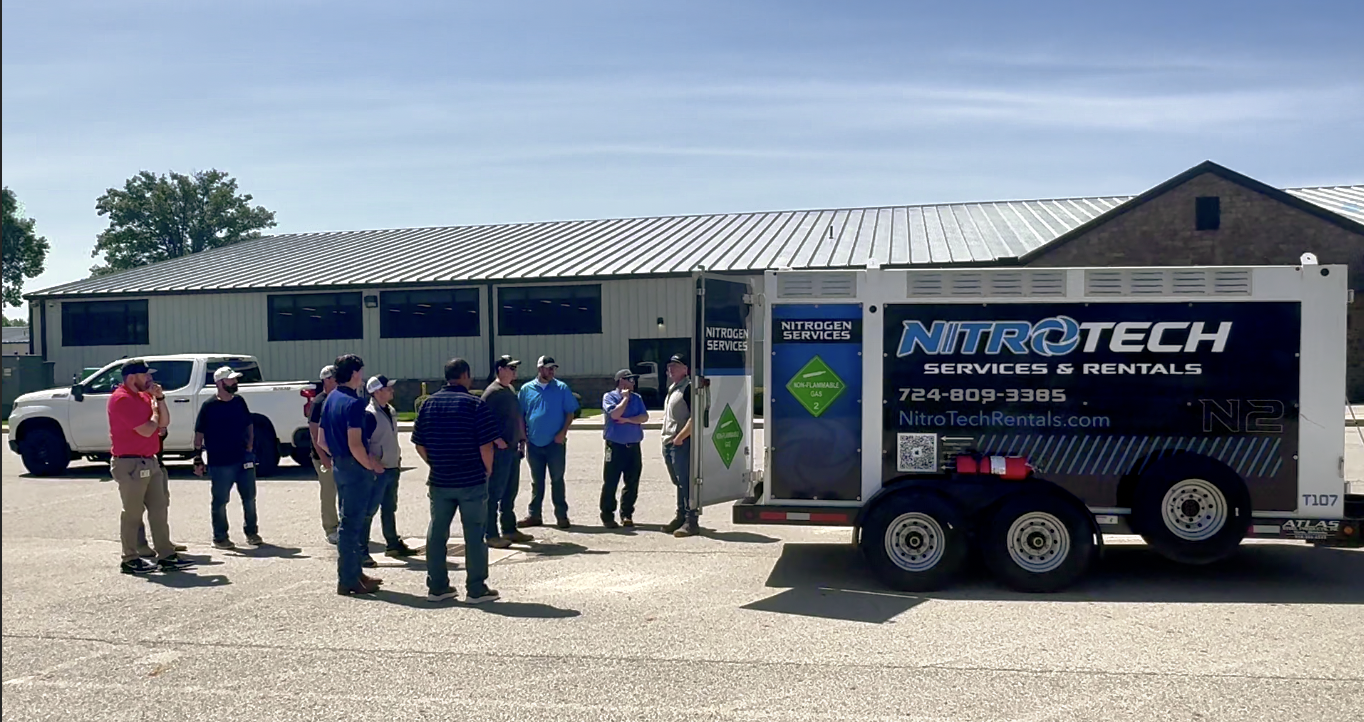
NitroTech designed its nitrogen trailers around a different assumption: that the people doing nitrogen work in the field should be able to move the equipment themselves, with the trucks they already own and operate. Our bumper-pull trailers move with a standard pickup truck rated for the load. Standard bumper-pull trailer. No semi-tractor required. No waiting for a dispatched commercial rig. This is the second of three differentiating engineering decisions that define NitroTech as an advanced N2 solutions company rather than a commodity rental provider.
NitroTech doesn’t build catalog equipment. We only build and deploy equipment where we believe we can engineer it meaningfully better than the standard industry approach. Pickup-truck mobilization solves a real cost and schedule problem for field crews — the kind of problem that doesn’t get solved by adding more capacity to a larger rig.
The CDL Bottleneck in Nitrogen Services
The Class A commercial driver shortage is one of the most-discussed labor issues in trucking. It is also one of the least-discussed cost drivers in industrial nitrogen services. Every standard nitrogen rig in the industry requires a CDL operator. That operator is in chronically short supply. That shortage drives up dispatch rates, lengthens mobilization windows, and forces project schedules to align with available driver hours instead of available job windows.
The downstream effects on industrial nitrogen projects are real and measurable:
- Mobilization delays of 2–5 days for non-emergency dispatches in many regions
- Premium dispatch rates for after-hours, weekend, or short-notice mobilization
- Constrained ability to reposition equipment mid-project when site conditions change
- Schedule risk when a CDL driver becomes unavailable on a specific day
- Hours-of-service constraints that artificially cap how long the rig can stay onsite
For East Coast industrial work — refinery turnarounds, chemical plant shutdowns, pipeline tie-in operations, data center commissioning — these CDL constraints translate directly into project schedule risk.
What Pickup-Towable Actually Means
A pickup-towable nitrogen trailer is not the same thing as a small nitrogen trailer. NitroTech’s bumper-pull trailers carry more usable high-pressure nitrogen product than typical competitors’ semi-tractor bobtails, in a trailer designed to be towed by a standard pickup truck rated for the gross trailer weight. This is the practical reality:
- Standard Class 3 or Class 4 pickup truck with appropriate hitch rating tows the trailer
- No semi-tractor or dedicated commercial rig required — CDL driver still operates the truck due to load weight
- Simplified route planning vs. oversize commercial vehicle permits
- The same operator who manages the nitrogen delivery on site can move the trailer
Field workforce flexibility is the real benefit. The crew that does the nitrogen work can also handle the logistics of getting the equipment to the next site or staging it differently within the current site.
The Mobilization Cost Comparison
The cost difference between a semi-tractor dispatch and a pickup-towable mobilization is significant on every individual job. Across a project, it adds up:
Single-Mobilization Cost
- semi-tractor bobtail mobilization: Driver day rate ($600–$1,200), tractor mileage ($2.50–$4.50/mile loaded), DOT compliance overhead, weight permit fees for some routes. Typical single-mobilization cost in the Northeast: $1,500–$3,500 depending on distance.
- Pickup-towable bumper-pull: Standard service truck operating cost ($0.75–$1.25/mile), no driver day rate premium, no DOT-CDL overhead, no route permits for standard routes. Typical single-mobilization cost in the Northeast: $400–$1,000 depending on distance.
Mid-Project Repositioning
The cost gap widens dramatically when a project requires repositioning during operations. A CDL driver returning to reposition a bobtail mid-project incurs a full second mobilization — including the driver’s return travel. A bumper-pull trailer is repositioned by the onsite crew at near-zero incremental cost.
Schedule Impact: When You Can Move the Equipment Yourself
The mobilization cost gap is significant. The schedule impact is often larger. On a fast-moving East Coast turnaround or data center commissioning project where every day of schedule has direct cost implications, the ability to mobilize a nitrogen trailer in hours instead of days can be the difference between hitting a critical path milestone or missing it.
Practical examples from East Coast operations:
- Refinery turnaround tie-in change: Mid-turnaround scope changes require nitrogen at a different unit than originally planned. semi-tractor: 24–48 hour dispatch delay. Pickup-towable: same-day repositioning by the onsite operator.
- Data center building handoff: A hyperscale construction site finishes Building 2 and is ready for Building 3 commissioning earlier than schedule. semi-tractor: next-business-day dispatch. Pickup-towable: trailer moved 200 yards by the operator that morning.
- Pipeline tie-in weather window: A weather-sensitive pipeline tie-in needs nitrogen on short notice during a brief good-weather window. semi-tractor: probably miss the window. Pickup-towable: operator hooks up and drives.
Permit and Route Advantages
Beyond the driver question, bumper-pull trailers operate under standard vehicle rules rather than commercial vehicle rules. Practical consequences:
- No weight-station check-ins on standard routes
- No oversize-load permits for typical mobilization distances
- Standard insurance coverage instead of commercial trucking insurance requirements
- Access to roads and bridges that exclude commercial vehicles — including some refinery and chemical plant access routes that have weight or width restrictions
- Simplified municipal coordination for movement through restricted-vehicle zones in urban industrial areas
For East Coast work in particular — where dense industrial corridors are bisected by old roads, low-clearance bridges, and weight-restricted municipal infrastructure — these permit advantages translate into real operational flexibility.
Emergency Response and After-Hours Coverage
Industrial emergencies do not happen on a CDL driver’s schedule. When a refinery has an unplanned vessel opening that requires nitrogen inerting, or a data center has an accidental fire suppression discharge that needs emergency recharge support, the question is how fast nitrogen can be on location.
NitroTech’s pickup-towable design means our emergency response is not gated on driver availability. The operator who handles the nitrogen work can also handle the mobilization — reducing emergency response time from a multi-step dispatch sequence to a single hookup-and-drive operation. For East Coast facility managers who have experienced the frustration of waiting for a CDL driver during an emergency, this is a meaningful operational advantage.
When Pickup-Towable Is Not the Right Answer
To stay intellectually honest: sustained high-volume operations over multi-week periods, with permanent staging areas designed for full-size rigs, may still favor traditional bobtail equipment. Mainline pipeline operations that move continuously down a right-of-way over weeks or months sometimes work better with a fleet of semi-tractor rigs leapfrogging the work face.
NitroTech does not pretend to be the right answer for those projects. We are an advanced N2 solutions company focused on the operations where mobilization speed, footprint, and field flexibility matter. If your project needs a continuous mainline rig fleet, hire a mainline rig fleet. If your project needs nitrogen on location, mobilized fast, by a single operator who can also do the work — that is exactly where we work.
Cut Mobilization Cost and Schedule Risk
Contact NitroTech to discuss your project’s mobilization requirements. We’ll be honest about whether pickup-towable is the right fit or whether a different approach makes more sense for your scope.
Related Resources
NitroTech Rentals is a division of HydroTech Testing — advanced N2 solutions, engineered where it matters. Nitrogen services, hydrostatic testing, and field operations support across the Eastern United States.