
Refinery turnarounds in the Delaware Valley, New Jersey, Pennsylvania, and the broader East Coast industrial corridor are some of the most logistically constrained nitrogen jobs in North America. The combination of older facility layouts, dense plant infrastructure, and strict union-controlled access scheduling means that nitrogen trailer logistics is not an afterthought — it is often the binding constraint on the entire turnaround critical path.
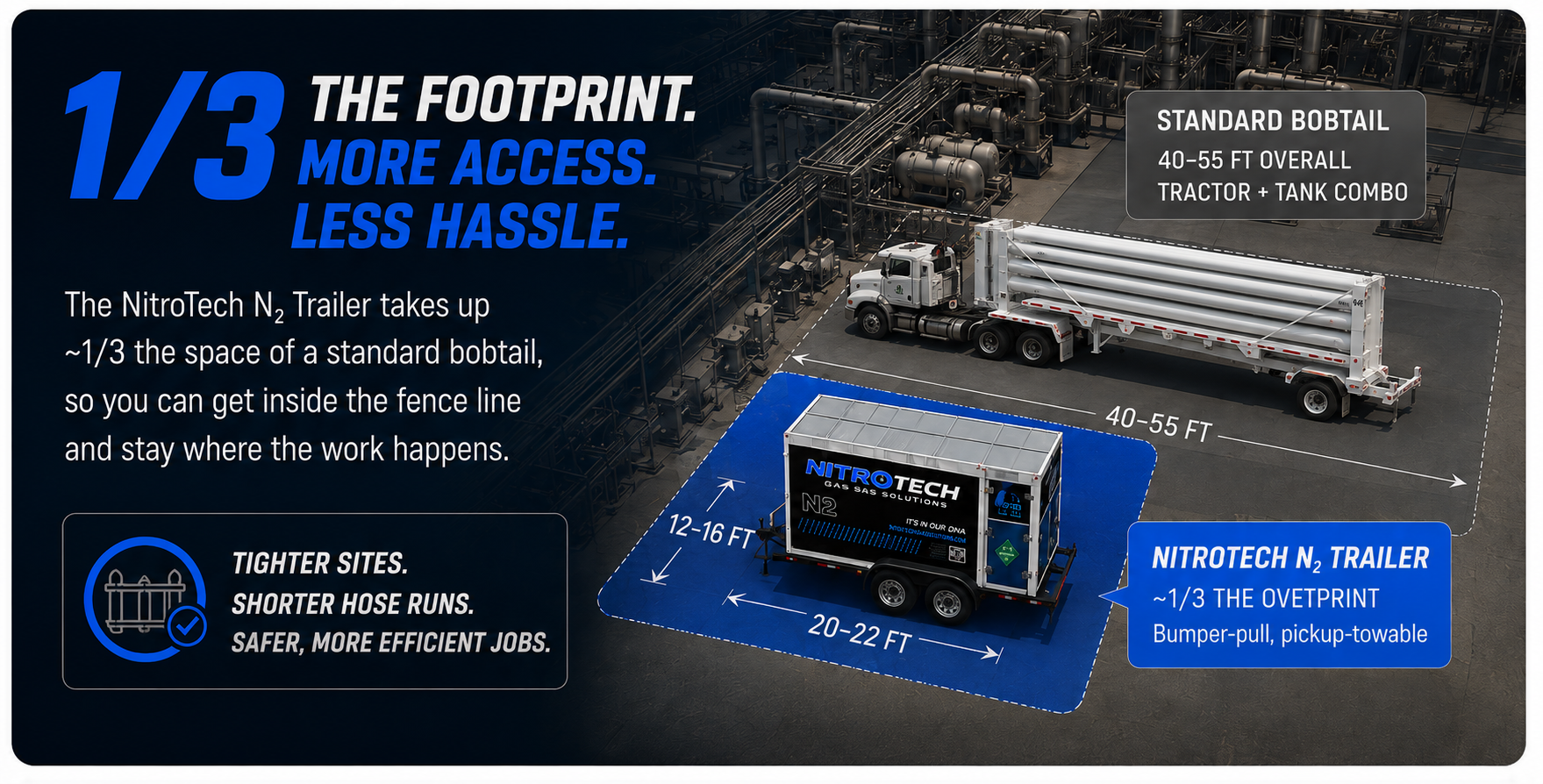
Trailer footprint determines where nitrogen can be staged. Where nitrogen can be staged determines how long the hose runs are. Hose run length determines pressure drop, setup time, and operational complexity. And operational complexity determines whether your turnaround hits its restart date or extends.
NitroTech is an advanced N2 solutions company. We don’t try to be everyone’s refinery nitrogen vendor. We focus specifically on East Coast turnaround work where our bumper-pull trailers reach process units that bobtails cannot — turning a logistics challenge into a routine operation. If your refinery has full semi access throughout the facility, you don’t need us. If you’ve been wrestling with hose runs and outside-fence staging, that’s where we work.
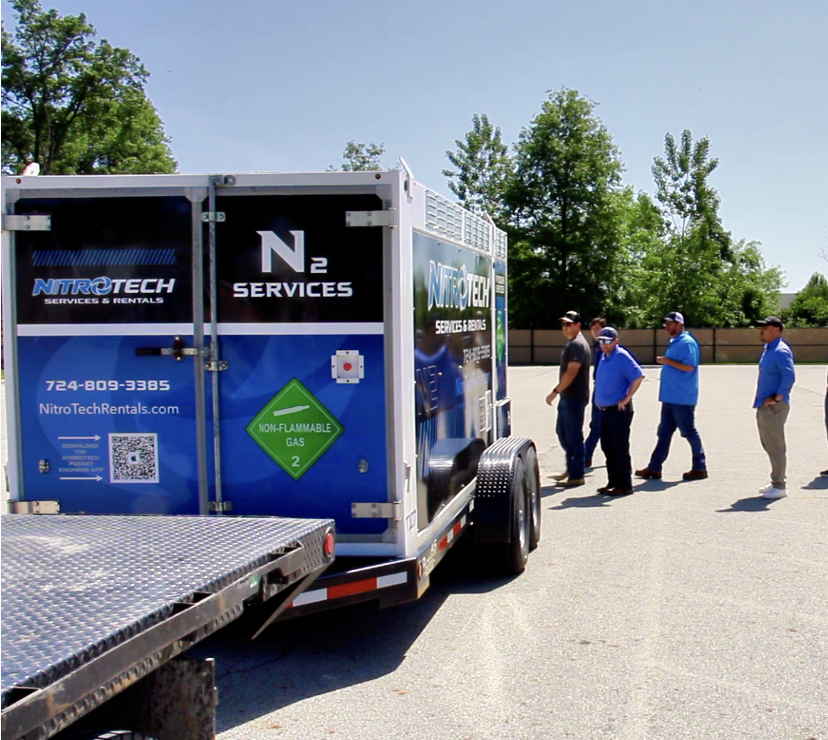
The East Coast Refinery Access Reality
East Coast refineries were built across several distinct eras, none of which were planned around modern Class A nitrogen rig dimensions. The Phillips 66 Bayway, PBF Energy Paulsboro, and Monroe Energy refineries all have access constraints that are characteristic of the Northeast industrial corridor:
- Internal plant access roads sized for service trucks rather than semi-tractor combinations
- Pipe rack overhead clearances that limit vehicle height
- Process unit access points designed for personnel and equipment access, not nitrogen rig staging
- Permit and Marine zone restrictions in port-area refineries that further constrain commercial vehicle access
The result is that nitrogen logistics on East Coast refinery turnarounds becomes a continuous negotiation between trailer placement, hose run distance, and operational complexity. Smaller-footprint equipment converts that negotiation into a straightforward operation.
How Trailer Footprint Cascades Through the Turnaround Schedule
Footprint sounds like a tactical concern. It is actually a strategic one. Here is how trailer footprint cascades through the turnaround schedule:
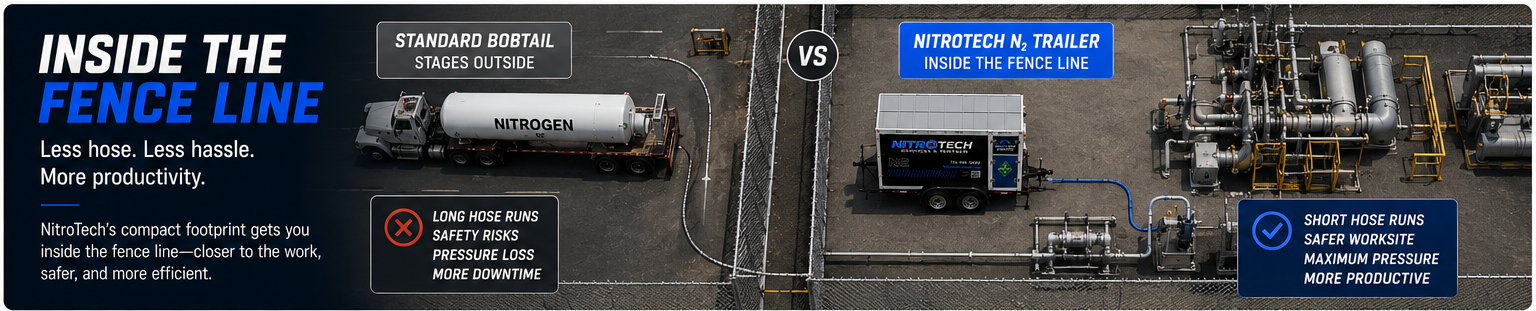
- Day 1: Bobtail rig cannot enter Unit X access road. Stages outside fence line.
- Day 1: 300 feet of high-pressure hose run installed from staging to tie-in point. Setup time adds 4 hours vs. inside-fence staging.
- Day 2: Hose pressure drop is higher than calculated. Delivery pressure at tie-in is marginal. Extra regulation hardware added to compensate.
- Day 4: Adjacent trade needs to use the access road blocked by the bobtail. Negotiations and partial repositioning consume half a day.
- Day 7: Turnaround scope adds a second nitrogen tie-in at Unit Y. Bobtail repositioning requires CDL driver dispatch and 24-hour delay.
- Day 12: Restart preparation behind schedule due to nitrogen logistics. Critical path slip.
This is not a worst-case scenario. This is a typical scenario on a constrained East Coast refinery turnaround when nitrogen logistics are not designed around the actual access constraints.
Delaware Valley, Pennsylvania, and New Jersey Examples
Specific East Coast refining and petrochemical sites where bumper-pull access changes the logistics equation:
Delaware Valley Refining Corridor
The Marcus Hook and former Philadelphia Energy Solutions sites have intra-plant access roads that pre-date modern trailer sizing. Bumper-pull trailers reach catalyst handling areas, vessel openings, and pipe rack tie-in points that full-size rigs simply cannot approach.
Phillips 66 Bayway Refinery (Linden, NJ)
The Bayway complex has dense internal pipe rack infrastructure and permit-restricted port-area access. Nitrogen rigs working at process units inside the fence line require equipment dimensions that respect the access reality. Bumper-pull design enables direct unit tie-in vs. extended hose runs from staging outside.
PBF Paulsboro and Delaware City
The Paulsboro and Delaware City refineries have access road weight restrictions and bridge clearances that constrain commercial vehicle movement. Bumper-pull trailers operating under standard vehicle rules navigate these restrictions where commercial rigs require permit coordination.
The True Cost of Extended Hose Runs
The most common consequence of nitrogen rig footprint being too large for direct unit staging is extended hose runs. The costs of extended hose runs are typically not on the nitrogen vendor’s invoice but show up everywhere else in the project:
- Pressure drop across hose length requires higher source pressure and adds regulation complexity
- Setup and breakdown time for extended hose runs adds hours to each tie-in change
- Hose routing through adjacent trade work zones creates coordination overhead and safety review requirements
- Each additional fitting in a long hose run is a leak risk point
- Hot work permit zones along extended hose paths add permit administration overhead
For a multi-week turnaround with continuous nitrogen operations, the cumulative cost of these hose run consequences typically exceeds the nominal rental cost difference between equipment options — while the schedule consequences are often substantially larger than any cost difference.
Staging Flexibility and Schedule Resilience
The hidden benefit of bumper-pull nitrogen trailers on refinery turnarounds is the staging flexibility they provide when the turnaround scope changes — which it always does. Refinery turnarounds are characterized by continuous scope adjustment as inspection findings reveal additional work, mechanical issues emerge during disassembly, or unit handoff sequences are revised based on actual completion times.
When the scope changes, nitrogen tie-in locations change. Bumper-pull trailers reposition by the onsite operator in minutes to hours. Full-size rigs require CDL driver dispatch and 24–48 hour repositioning timelines. The result is that bumper-pull-equipped turnarounds absorb scope changes without nitrogen logistics becoming the binding constraint on schedule recovery.
What to Ask a Nitrogen Vendor Before a Turnaround
For East Coast refinery turnaround coordinators evaluating nitrogen service providers, the questions that actually predict logistics performance:
- What is the trailer footprint at staging? Not just length — total area required including hookup access.
- Can the trailer enter the unit fence line or does it stage outside? Outside staging means extended hose runs — ask about hose run length to specific tie-in points.
- How long does repositioning take if the scope changes mid-turnaround? If the answer involves dispatching a CDL driver, expect 24–48 hours.
- Does the operator move the trailer or is it driven by a separate CDL driver? Separation between operator and driver means a coordination layer that adds delay.
- What is the cost of mid-turnaround repositioning? Get the answer in writing before the turnaround.
NitroTech provides clear answers to all of these questions before a turnaround. Our equipment is designed around East Coast refinery access constraints — not adapted to them.
Planning a Refinery Turnaround?
Contact NitroTech early in your turnaround planning. We’ll walk through your unit access reality and confirm whether bumper-pull nitrogen logistics deliver real schedule value for your scope.
Related Resources
NitroTech Rentals is a division of HydroTech Testing — advanced N2 solutions, engineered where it matters. Nitrogen services, hydrostatic testing, and field operations support across the Eastern United States.