
The chemical manufacturing corridor that runs from Wilmington, Delaware through New Jersey’s I-95 industrial zone and up into the specialty chemical clusters of Massachusetts and Connecticut is one of the most nitrogen-intensive industrial concentrations in North America. It is also one of the most access-constrained. Bumper-pull nitrogen trailers exist because the chemical plant access reality required equipment that fits where catalog rigs cannot go.
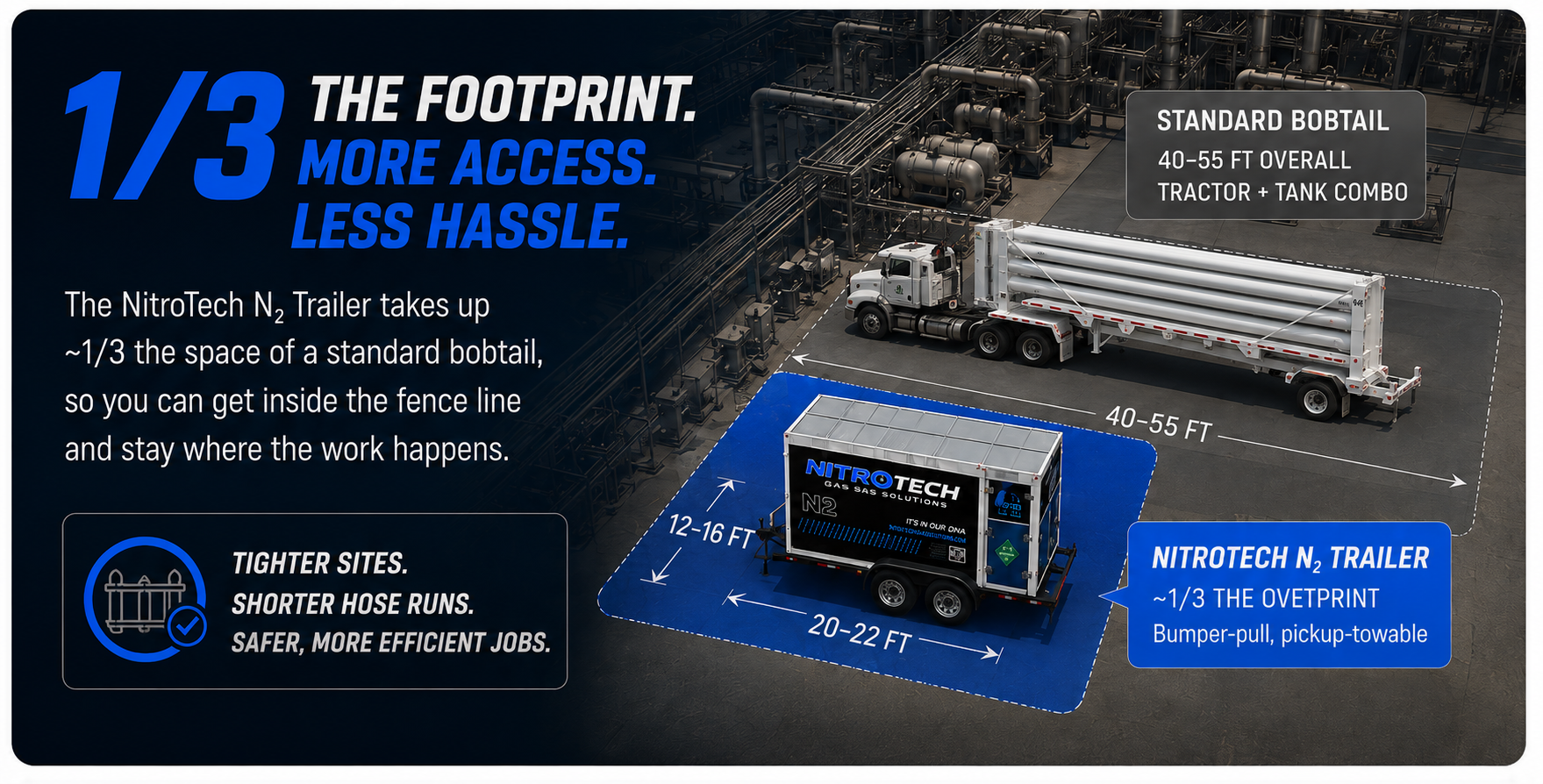
Chemical plant access is where the bumper-pull design proves its value most clearly. We’re not a full-line industrial gas supplier — we’re an advanced N2 solutions company that focused specifically on the operations where access, footprint, and field execution determine whether the work can actually be done. If your plant has full semi access throughout, you don’t need us. If your plant has the access reality the Northeast chemical corridor was built around, that’s where we work.
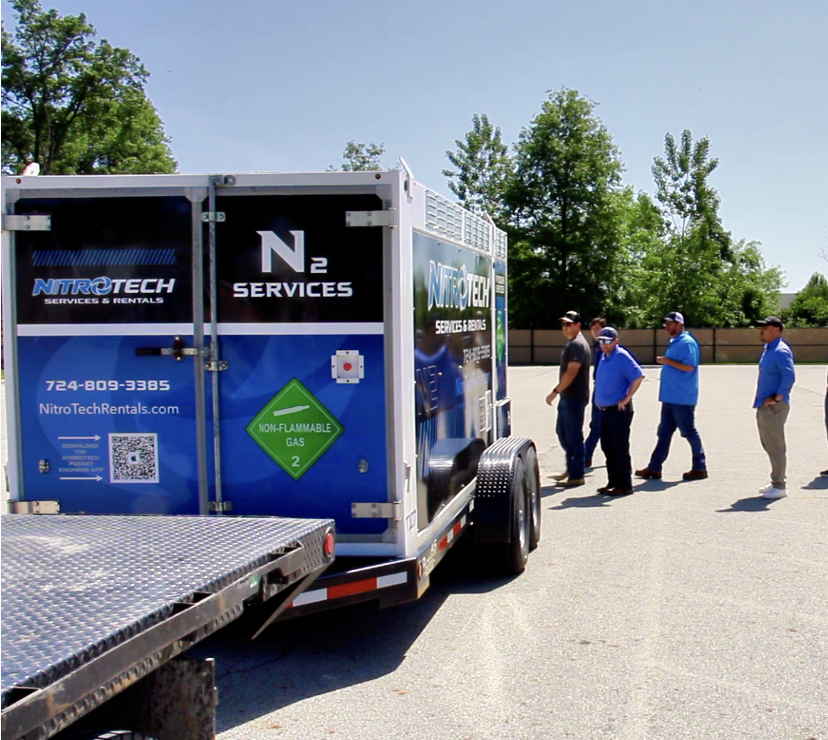
The Northeast Chemical Corridor Access Reality
The Northeast chemical manufacturing corridor was built across many decades. The oldest plants pre-date interstate highways and modern commercial vehicle dimensions entirely. Even the newer specialty chemical and pharmaceutical facilities, often built on the footprints of older plants, inherit access constraints from their predecessors. Common realities:
- Plant access roads designed for service trucks and personnel vehicles, not modern Class A commercial rigs
- Pipe rack overhead clearances that constrain vehicle height in many internal plant areas
- Process building access points sized for equipment dollies and maintenance carts, not nitrogen rig parking
- Permit zone restrictions that add commercial vehicle coordination complexity even where physical access exists
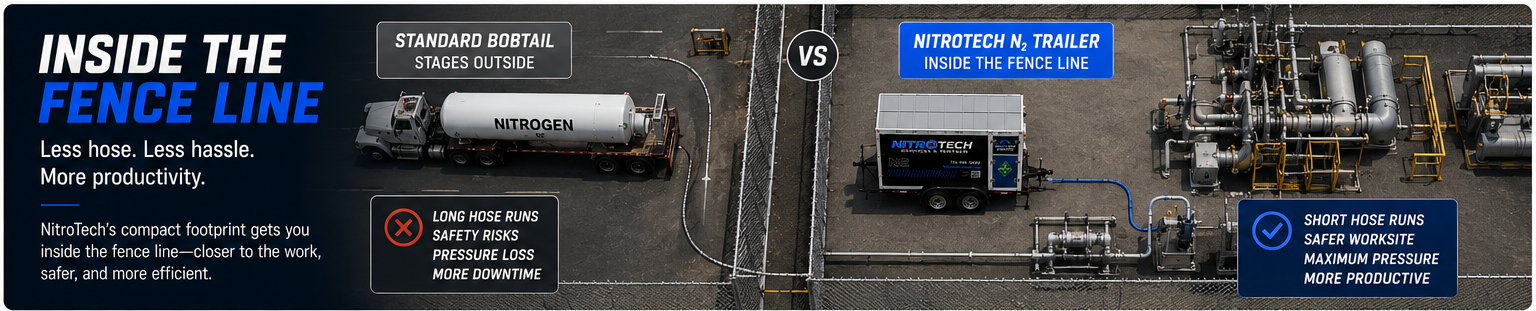
Inside-Fence vs. Outside-Fence Staging
The most consequential nitrogen logistics decision on a chemical plant maintenance window is whether the rig stages inside the unit fence line or outside. Inside-fence staging means hose runs measured in tens of feet. Outside-fence staging often means hose runs measured in hundreds of feet, with all the pressure drop, regulation complexity, leak management, and trade coordination overhead that creates.
Bumper-pull trailers achieve inside-fence staging at chemical plants where bobtails physically cannot enter. This is not a marginal operational difference. It is the difference between nitrogen logistics being routine and nitrogen logistics being the binding constraint on the maintenance window schedule.
Specialty Chemical and Pharmaceutical Facility Realities
Specialty chemical and pharmaceutical manufacturing — particularly New Jersey’s pharma cluster — adds another layer of access constraint. These facilities have stringent change control, security, and contamination protection requirements that further restrict commercial vehicle access. Practical consequences:
- Visitor and vehicle screening procedures that add hours to commercial vehicle entry
- Restricted vehicle types in certain plant areas regardless of physical access
- Limited staging zones with strict overnight parking restrictions
- Coordination requirements that favor smaller equipment with fewer logistics dependencies
For pharmaceutical and specialty chemical maintenance work, bumper-pull access is often the only practical option that meets both physical access and operational access requirements.
Delaware and New Jersey Major Plants
Specific Delaware Valley and New Jersey chemical manufacturing facilities where bumper-pull access changes the logistics equation:
DuPont / Chemours Wilmington and Brandywine Corridor
The DuPont and Chemours facilities along the Brandywine Creek industrial corridor have intra-plant access constraints reflecting their long operational history. Bumper-pull trailers reach process areas that pre-date modern commercial vehicle dimensions.
New Jersey Specialty Chemical Cluster
The dense specialty chemical and pharmaceutical manufacturing cluster across New Jersey, particularly in Middlesex, Somerset, and Morris Counties, includes facilities built across multiple eras with access constraints that vary by plant section. Bumper-pull trailers navigate this access variability where full-size rigs require plant-by-plant access negotiation.
Linden / Bayway Industrial Complex
The Linden/Bayway industrial complex includes both refining and petrochemical processing operations. The pipe rack density and intra-plant access road network favor smaller-footprint equipment for nitrogen tie-in operations.
The Permitting and Coordination Savings
Beyond physical access, bumper-pull trailers eliminate or reduce several categories of permitting and coordination overhead that accompany commercial vehicle access to chemical plants:
- Standard vehicle entry procedures instead of commercial vehicle entry protocols
- No commercial vehicle credentials to clear through plant security
- Standard insurance documentation instead of commercial vehicle insurance verification
- Simplified site access scheduling without commercial vehicle coordination layers
For chemical plants that have experienced delays from these administrative requirements during prior maintenance windows, bumper-pull mobilization often eliminates entire categories of access friction.
When This Matters and When It Doesn’t
Bumper-pull access matters most for chemical plants with the access constraints typical of the Northeast corridor. For chemical plants built in the past 30 years on greenfield sites with modern commercial vehicle access throughout, the access advantage is smaller. NitroTech is honest about this. We focus on the chemical plant work where our equipment delivers measurable logistics value. We do not pretend to be the right answer for facilities where standard access exists throughout the plant.
Chemical Plant Maintenance Coming Up?
Contact NitroTech to discuss your specific plant access reality. We’ll walk through whether bumper-pull access delivers schedule and logistics value for your scope.
Related Resources
NitroTech Rentals is a division of HydroTech Testing — advanced N2 solutions, engineered where it matters. Nitrogen services, hydrostatic testing, and field operations support across the Eastern United States.